

We Are Unmuted: Respecting the Craft with Tony Gemignani
On this episode of We Are Unmuted, we sat down with Tony Gemignani—world-renowned pizza maker, restaurateur, and industry leader whose impact goes far beyond the kitchen. With over three decades of experience, Tony has built a career not just on mastering his craft, but on challenging an industry that wasn’t always ready for change.
From introducing multiple pizza styles under one roof to openly sharing knowledge in a traditionally guarded space, his work lives at the intersection of craft, risk, and innovation.
But behind the accolades and expansion is a story rooted in something much more personal: learning to find your voice, take risks before you feel ready, and show up fully—again and again.
In this conversation, Tony shares what it really looks like to build something from the ground up, stay ahead of the curve, and remain unmuted through every stage of the journey.
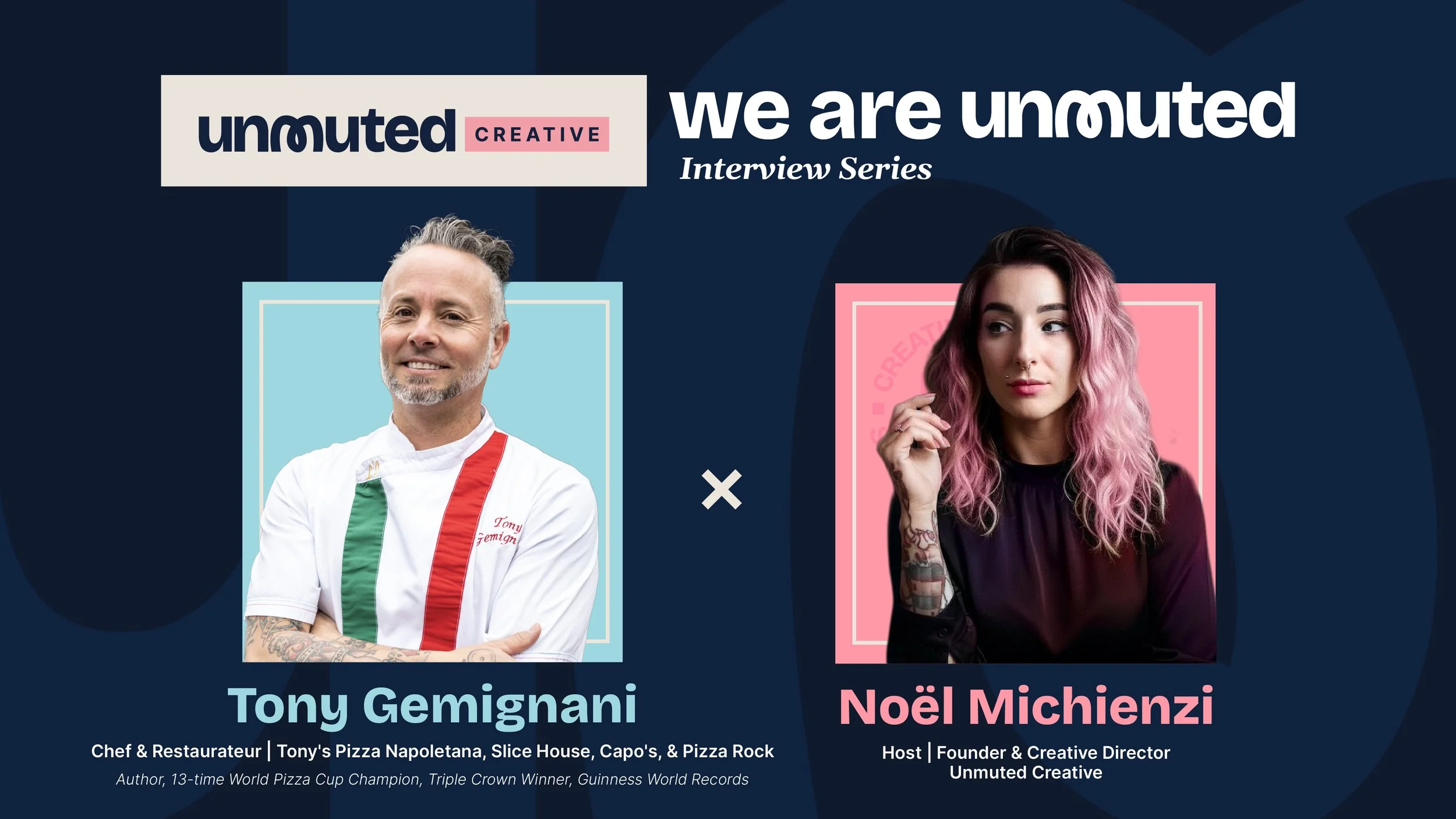
Watch the full interview on our YouTube channel to follow every We Are Unmuted interview.
Q&A with Tony Gemignani
Noël: Can you start by sharing a bit about your background and what you do?
Tony:
I’ve been in the business for almost 35 years. I got into it when I was about 17, turning 18. I grew up in Fremont, California, and my brother opened a pizzeria in Castro Valley—we ran that together for about 17 years.
From there, I went on to do my own thing in San Francisco. Now I have multiple concepts, including Slice House, which has grown nationally, and Pizza Rock in Las Vegas. I’ve expanded into stadiums, arenas, and different types of concepts—even bakeries and specialty shops.
Over the years, I’ve written books, traveled the world making pizza, and taught for about 15 years—certifying chefs who went on to open their own restaurants.
I’m known for doing all styles of pizza, which was kind of different at the time. Most people stuck to one style, but I brought them all together.
Noël: Why pizza? What made you fall in love with it?
Tony:
It really started with my brother. I didn’t know what I wanted to do after high school. I was taking some college courses, trying to figure it out.
Then I started making pizza—and I fell in love with it.
I’ve always loved cooking. My mom cooked all the time, and I took home economics classes in school and actually enjoyed them. But what really got me was how rewarding it felt to make something with my hands and watch someone enjoy it.
That feeling never left.
Noël: You’ve always stood out for doing things differently. Where did that mindset come from?
Tony:
It goes back to my mom.
She grew up in a very strict household and didn’t have a lot of opportunities. She always told me:
“Be what you want to be. Do what you want to do.”
I was really shy as a kid—head down in class, nervous to speak. But over time, I started pushing myself into uncomfortable situations.
That mindset carried into everything—how I dressed, what I tried, and eventually how I approached business.
Noël: What inspired you to take risks in an industry that was so traditional?
Tony:
The pizza industry used to be very territorial. If you were New York style, that’s all you did. Same with Chicago, Neapolitan, Roman—no overlap.
I didn’t see it that way.
I traveled early in my career and experienced all these styles, and I thought:
If it’s made right, it’s great—no matter what style it is.
So I brought them together under one concept. At the time, that wasn’t really accepted. But I didn’t care—I believed in it.
Noël: You also chose to share knowledge in an industry that didn’t typically do that. Why?
Tony:
Back then, everything was secretive. Recipes were guarded, techniques weren’t shared.
I took the opposite approach.
If I can teach someone to be great, that’s more rewarding than just doing it myself.
That’s where the school came from, the team, everything. I wanted to build something bigger than just me.
Noël: Do you think that approach helped you get ahead?
Tony:
Yeah, I think it helped create the curve.
Now it’s common to see places offering multiple styles—but back then, it wasn’t. People started watching what I was doing.
It wasn’t just about being different—it was about being early.
Noël: You’ve mentioned pushing yourself outside your comfort zone. What did that look like?
Tony:
I took improv classes and acting-type courses because I knew I might end up on TV someday.
At the time, that was a big goal—getting on shows like The Tonight Show.
Those classes helped me think on my feet, be more confident, and control conversations.
Eventually, I did get on The Tonight Show. And back then, that was everything. If you made it there, you made it.
Noël: What was your first big break?
Tony:
Winning a pizza acrobatics championship was a big one.
But getting on The Tonight Show was the pinnacle.
Back then, there wasn’t social media—you had to send VHS tapes, go through intense interviews, and prove yourself in real time.
So that moment meant a lot.
Want more conversations like this? Subscribe to We Are Unmuted and follow along as we continue highlighting people who are redefining systems, culture, and community, unapologetically.
Noël: Was there ever a moment where you felt like you had to do things differently or go against the grain?
Tony:
My whole life has been like that.
People were always asking:
“Why are you doing this?”
“Why would you teach your secrets?”
“Why would you open something like that?”
I didn’t have funding, I didn’t have a formal business plan—I just had ideas and figured it out along the way.
A lot of it was learning the hard way.
Noël: You’ve built so much from the ground up—what has that taught you?
Tony:
It taught me everything.
I didn’t have the resources people have now—no decks, no formal agreements, no roadmap.
It was trial and error.
But those experiences shaped how I run my business today—and how I teach others.
Noël: You talk a lot about mentorship. What does that look like for you now?
Tony:
A lot of it is with my son.
I try to teach him through experience—bringing him to work, showing him what it’s really like.
Not just the fun parts, but the challenges too.
I don’t force anything. I just expose him to it and let him figure it out.
Noël: Do you think he’ll follow in your footsteps?
Tony:
I don’t know.
He says he wants to, but he has a lot of interests—sports, surfing, things I didn’t have growing up.
And honestly, the restaurant industry is tough. It’s rewarding, but it’s hard.
I just want him to be happy doing whatever he chooses.
Noël: What do you think is different for someone entering the industry today?
Tony:
There’s a lot more structure now—HR, technology, social media.
Back then, none of that existed.
Now, you have systems, tools, and platforms that can help you grow faster, but you also have to navigate them correctly.
Noël: What’s something people don’t talk about enough in your industry?
Tony:
The rise of women in pizza.
For a long time, it was a male-dominated space—especially in competitions.
Now there’s a huge movement, and it’s amazing to see.
Some of the women who worked with me early on are now leading that movement and doing incredible things.
Noël: What does being “unmuted” mean to you?
Tony:
It’s about pushing past that part of you that wants to stay quiet.
There’s always that version of you that’s scared, that wants to hold back.
For me, being unmuted is choosing to push forward anyway.
It’s about drive, competitiveness, and not being afraid to fail.
I’ve had setbacks. I’ve struggled. But I’ve always had that voice saying:
“Get back up. Do it better.”
Noël: What continues to drive you today?
Tony:
That same competitiveness.
That same desire to prove—to myself more than anyone else—that I can keep growing.
And honestly, I still hear my mom’s voice in my head: “Do what you want to do.”
That never leaves you.
Noël: Where can people find you and support your work?
Tony:
You can follow along with what I’m doing on my website, I try to keep that updated with my restaurants, books, and everything I’ve got going on.
I’m also on social media—Instagram, Facebook—where I share more day-to-day, what’s happening in the kitchens, events, and new projects.
If you’re in San Francisco or any of our locations, the best way to support is just to come in, try the food, and experience it for yourself.
Facebook:/Tony.Gemignani.5
Instagram: @CapoPizza
LinkedIn:@TonyGemignani
Website:TonyGemignani.com
Final Thoughts
Tony Gemignani reminds us that mastery isn’t just about perfecting your craft…it’s about evolving it. It’s about having the courage to challenge tradition, share what others keep guarded, and build something bigger than yourself along the way. This is what it looks like when passion isn’t just pursued, but practiced over decades.
Being unmuted, as Tony shows us, isn’t a single moment, it’s a series of choices. Choosing to take the risk, and stepping outside of what’s expected. Choosing to keep going, even when there’s no clear path forward. It’s not about being fearless, it’s about moving anyway.
To watch the full interview and more, subscribe to the We Are Unmuted newsletter below or our YouTube channel.
