

We Are Unmuted: Telling Stories that Create Real Change with Owen Seabrook
Some people are drawn to filmmaking because they love cameras or cinema. For Owen Seabrook, it started with a single moment watching Hook on VHS and wondering why five seconds of storytelling could completely change how he felt.
Today, Owen is a Commercial Director, filmmaker, and Co-Founder of Tell Studio, a production company dedicated to creating emotive films for socially conscious brands and organizations. From documentaries used as educational tools across hundreds of organizations to campaigns that have raised millions for youth initiatives, his work proves that storytelling isn't just about creating beautiful visuals; it's about creating measurable impact.
In this conversation, we explore the intersection of film, design, creativity, authenticity, AI, and why being "unmuted" means believing you have the power to rearrange the world around you.
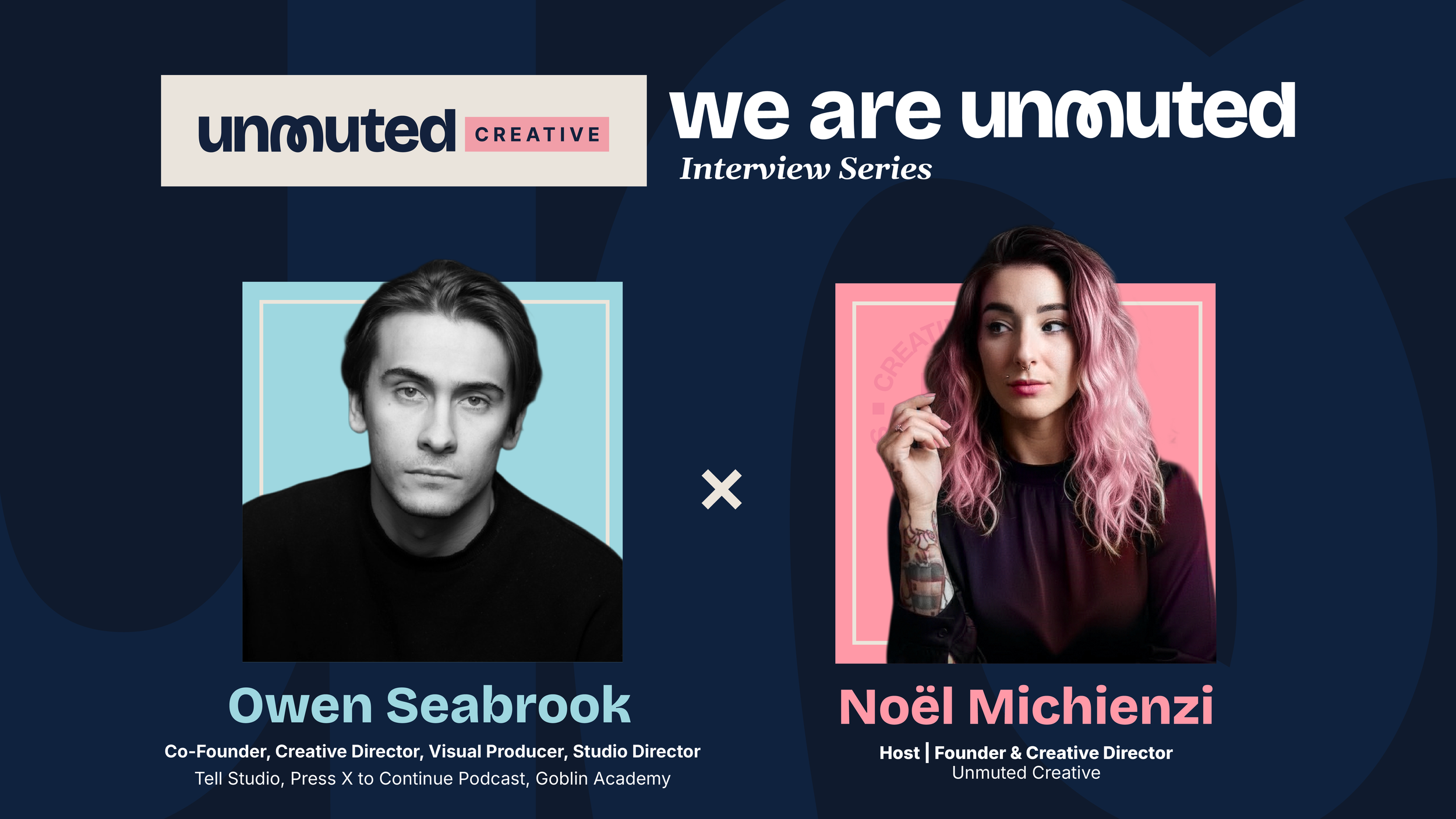
Watch the full interview on our YouTube channel to follow every We Are Unmuted interview.
Q&A with Owen Seabrook
Noël: What first drew you into filmmaking?
Owen:
I've always been fascinated by the puzzle of storytelling.
I remember watching Hook on VHS as a kid and seeing Robin Williams reveal himself on the ship's mast. Five seconds earlier I wasn't excited, and then suddenly I was completely invested. I became obsessed with figuring out what happened in those five seconds to make me feel that way.
That curiosity never left.
I also grew up on Jim Carrey movies, Dumb and Dumber is still my favorite film, despite everyone in film school trying to convince me otherwise. I wanted to understand how technical decisions behind the camera could make someone laugh, cry, or feel something real.
Noël: Have you ever figured out what that "little thing" is?
Owen:
I think filmmaking is a language.
Every decision—the lens, the camera angle, the edit, the typography, the music—is part of communicating a message. When those decisions all support the same idea, the audience experiences something much bigger than any one individual element.
It's really just thousands of intentional choices working together.
Noël: Tell Studio focuses on socially conscious organizations. Why was that important to you?
Owen:
My business partner Lewis and I both found ourselves creating work that wasn't particularly fulfilling.
I was making content for industries like single-use plastics and fishing, and even though I enjoyed the craft, something felt missing.
So we asked ourselves:
What if there was a production company that simply supported good people doing good things?
That idea became Tell Studio.
Everything we've done since has been rooted in helping organizations creating positive social or environmental change tell their stories better.
Noël: Do you think smaller creative studios have an advantage today?
Owen:
Absolutely.
More creatives are becoming multidisciplinary. I've taught myself editing, motion graphics, camera work, and a lot of other skills simply because I wanted to understand the whole process.
That means a small team can create work that looks incredibly polished without needing a massive agency structure.
You don't necessarily need huge overhead or dozens of departments anymore. Sometimes ten passionate people can create something just as impactful.
Noël: How do you protect creative ideas throughout a project?
Owen:
That's always the battle.
The more layers there are between the client and the person actually creating the work, the easier it is for the original idea to get diluted.
Working directly with clients allows us to protect that creative vision from the initial brief all the way through delivery.
Noël: You've recently been experimenting with motion capture. What inspired that?
Owen:
We received funding to build a motion capture studio in Leeds, and we've been using it as both a creative playground and an educational space.
One of our first experiments involved bringing in a drag queen to perform death drops and choreography to see if a markerless motion capture system could keep up—and it did.
Our latest project is even stranger.
I've created a fictional character called the Goblin King, and the story is that wizards have started online beef with me, so naturally I've responded by writing a three-minute grime rap diss track entirely performed through motion capture.
It's ridiculous, but it's also a really fun way to explore what the technology can do.
Noël: Why is it important to keep experimenting creatively?
Owen:
Because it keeps everything fun.
Trying new tools, combining disciplines, and making weird ideas happen is what keeps the creative process exciting.
Those experiments often lead to the most interesting work.
Noël: We ask every guest this question: What does it mean to be "unmuted"?
Owen:
I think creativity is simply having an opinion and acting on it.
It's not a talent reserved for artists.
If you see a situation and believe you have the ability to rearrange it, improve it, solve a problem, or express an idea—that's creativity.
Being unmuted means feeling empowered to step in and make something better instead of only thinking about it.
Too many people tell themselves they're "not creative," and they rob themselves of so much joy.
The music you choose, the way you dress, the hobbies you pursue, the problems you solve—those are all creative acts.
Noël: We also talked about AI and authenticity. What's your perspective?
Owen:
I recently experimented with AI video generation on a small charity project because I wanted to understand the tool firsthand.
My biggest takeaway?
It's still incredibly boring compared to working with real people.
We're entering a moment where audiences are exhausted by automation. That creates an opportunity for creatives to lean even harder into humanity, collaboration, and authentic storytelling.
That's something technology can't replicate.
Noël: Any thoughts on authenticity in the age of LinkedIn thought leadership?
Owen:
I struggle in environments where I can't simply be myself.
That's why I intentionally have fun on LinkedIn instead of trying to sound like every other "thought leader."
Authenticity is far more interesting than perfection.
Sometimes the most valuable thing you can do is show up as yourself.
Final Thoughts
Throughout our conversation, one idea kept resurfacing: creativity isn't reserved for filmmakers, designers, or artists. It's a mindset.
It's the willingness to have an opinion, trust your instincts, embrace curiosity, and create something that didn't exist before.
Whether Owen is directing documentaries, building motion capture worlds, or writing rap battles between goblins and wizards, every project comes back to the same belief:
Stories have the power to make people feel something; when people feel something, they can change.
And maybe that's what being unmuted is all about.
To learn more about Owen and his amazing-ness:
Tell Studio:
Website: tell.studio
IG: /tellstudio
Follow Owen:
Website: owenseabrook.com
IG: /owenseabrook
Li: /owenseabrook
Spotify: Press X to Continue Podcast
